HOME
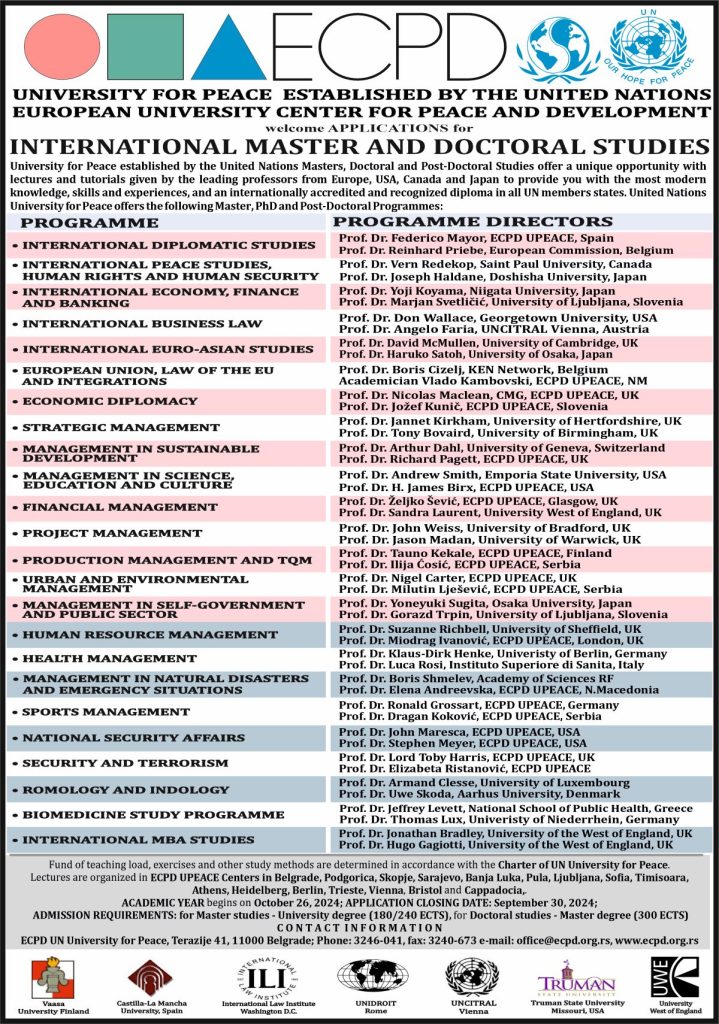
The accomplishments of the European Center for Peace and Development (ECPD) during its 25 years of activity – and its plans for the coming period – reflect its intellectual mission as set out in the founding acts of the ECPD. Its mission has remained unchanged: to contribute to peace and development in Europe as the area of the ECPD’s activities, and to international cooperation in the transfer of knowledge, by organizing international postgraduate studies (at the specialist, master’s and doctoral levels) and postgraduate professional training and specialization (postgraduate schools, specialist seminars, instructive and other courses) and research in the relevant scientific fields. The ECPD’s guiding principle has always been: through peace to development, through development to peace.
The ECPD has always operated primarily in Europe, at first in its south-eastern part, with an orientation towards the post-socialist countries that is, countries in transition. Nonetheless, in keeping with its program policy, it has increasingly been open for cooperation with the rest of the world.
The basic premise, upon which the ECPD has based its program orientation and strategy, has been that development under conditions of peace is only possible when conceived as human development.
It is undoubtedly true that a widening gap between developed and developing countries is causing internal and international tension and conflict, thus threatening peace in the world. But it is also true that the development of countries cannot be measured solely by the per capita growth of national income. If we want a stable world peace, we must strive towards human development by means of constant advance in the quality of human life. Education and, more generally, the diffusion of knowledge are the prerequisites for such qualitative improvement. In our view, the recent past, characterized by growing globalization of “good” and “bad” in the world is clear proof that the ECPD has chosen a topical and relevant strategy for its program orientation.
The improvement of the quality of life is achievable by taking a holistic approach to the solution of problems.
The European Center for Peace and Development has chosen an interdisciplinary approach by implementing the following seven, closely inter-connected and inter-linked programs:
- Development of human resources;
- Development of natural resources;
- Economic development;
- Scientific and technological development;
- Sustainable development;
- Cultural development;
- Management.